

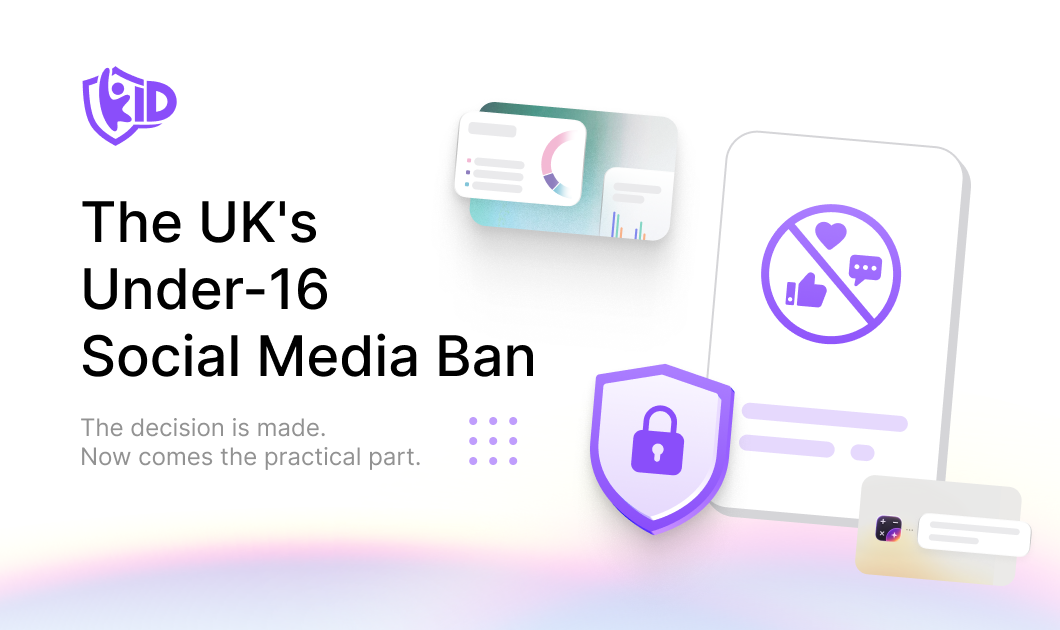
The UK just chose a full under-16 social media ban. Now comes the practical part: making it work.
This is not just a social media change: the new rules are expected to reach livestreaming and stranger-contact on gaming platforms too, so game publishers should be paying attention.
This morning the UK government announced that under-16s will be banned from social media, with rules due to take effect in early 2027. Prime Minister Keir Starmer called it "the right step for Britain." Australia moved first in December 2025, and the UK is following with a model that goes further.
The decision is the straightforward part. Setting an age limit is a policy choice. Delivering it is practical, well-understood work, and most of it comes down to age assurance. The platforms that treat that as core infrastructure, rather than a last-minute scramble, will find early 2027 manageable.
What was announced
A full ban, not softer limits. Under-16s will be blocked from major platforms, with the government naming Snapchat, TikTok, YouTube, Instagram, Facebook and X as examples. Private messaging is out of scope, and no exhaustive list has been released.
The UK approach goes further than Australia in three ways. It reaches functionality, not just access: platforms must stop under-16s from livestreaming and block strangers from contacting children, with these limits expected to extend to gaming services. It also turns those restrictions on by default for under-17s, so protection tapers rather than ending the moment a child turns 16. And it signals more to come, with overnight curfews, breaks in infinite scrolling and AI chatbot rules flagged for July.
The mandate is real. The "growing up in the online world" consultation drew more than 116,000 responses, with around 90 percent of parents backing a minimum age of 16.
The ban is definitive. Its shape is not yet.
The enabling law has already passed, the Children's Wellbeing and Schools Act 2026. The detailed rules will come through regulations the government plans to pass before Christmas. The platform list, the legal definition of "social media", enforcement and penalties, and most importantly the age assurance standard, are all still to be set. That makes the coming months the window to engage, not to wait.
The practical work is age assurance
An age limit is a policy decision. Meeting it is an architecture problem, and a solvable one.
No single check works for everyone. Reliable age assurance means orchestrating multiple methods and applying the right one for the context, which is what k-ID's AgeKit+ does.
The rules are about features, not just front doors. Blocking livestreaming, defaulting stranger-contact off for under-17s and layering in curfews are per-feature decisions that depend on age and jurisdiction. That is age-adaptive product behaviour, the job k-ID's CDK does.
Privacy is part of the test. Letting someone verify once and reuse the result, rather than handing over data again and again, is the difference between a safety measure and a new data-security risk. That is the case for reusable credentials like AgeKeys, built through the OpenAge Initiative.
And the rules will keep moving. Australia is live, and Canada, Brazil, the EU and others are close behind with their own definitions and dates. Keeping pace without a manual scramble is what neimo is for.
What platforms should do now
Map your exposure: which surfaces meet the definition, where livestreaming and stranger-contact features sit, and which users are likely under 17. Decide your age assurance approach before the standard is fixed. And build for the whole picture, because the strictest workable version tends to become what platforms ship everywhere. Designing age-adaptive behaviour once and configuring it per market beats rebuilding for each new law.
The UK has made its choice. The companies that handle it best will treat age assurance as core infrastructure, not a feature bolted on in 2027.